
Six ESG Highlights for 2026
With 2026 in full swing, many people are working to get their plans for the year moving forward. For ...
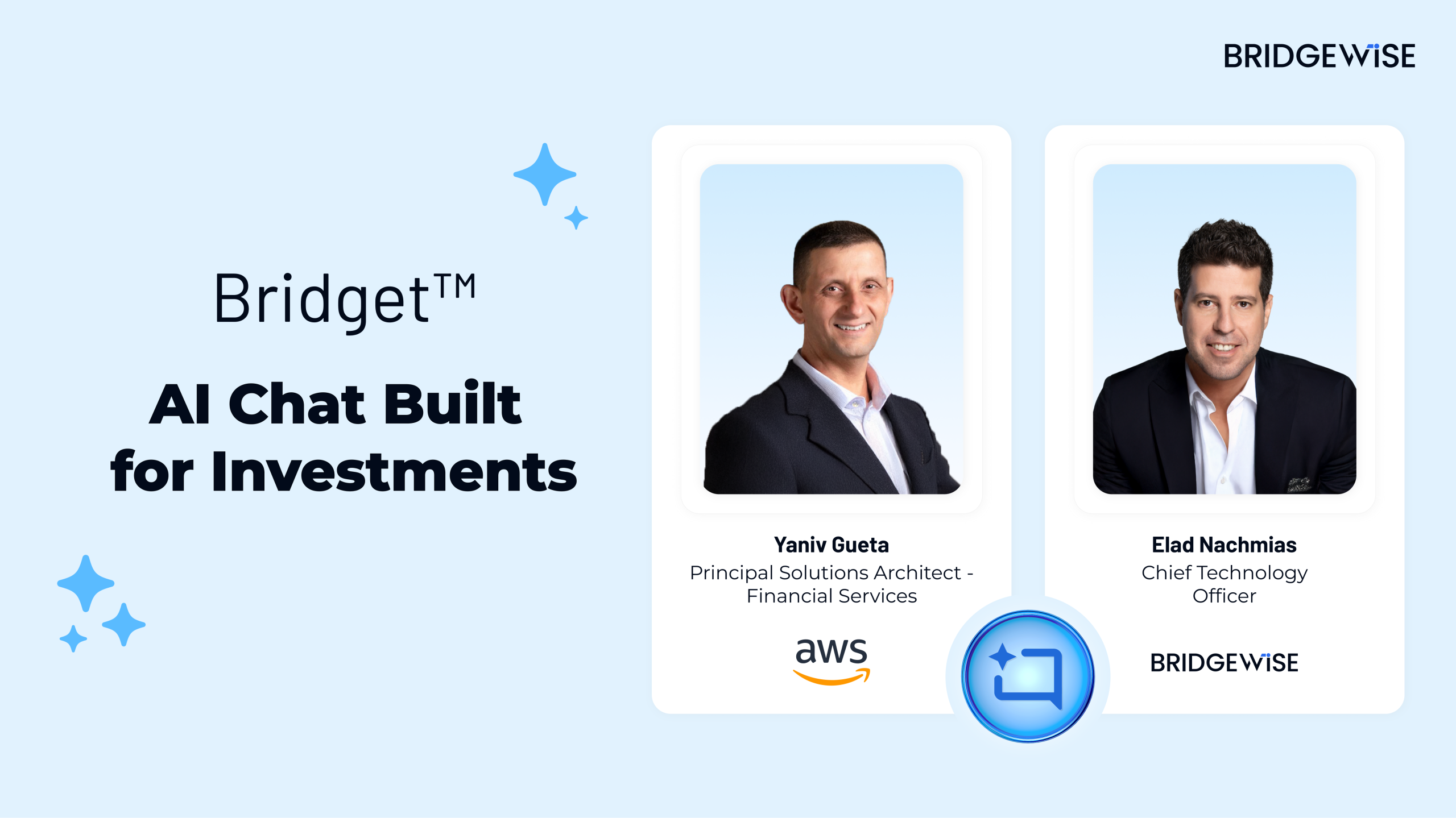
Generative AI has moved quickly from experimentation to production, but in financial services, enthusiasm alone isn’t enough. Accuracy, governance, explainability, and security are non‑negotiable. In a recent webinar, BridgeWise CTO Elad Nachmias and AWS Principal Solutions Architect Yaniv Gueta explained how BridgeWise’s AI chatbot, Bridget™, was designed to meet those standards, the specific technological solutions employed, and why most generic chatbots fall short in regulated environments.
Elad started by explaining the specific needs and demands of partners at financial institutions as they explored the idea of adding support for AI chat.
“If I go back two years to when we started building this product, and look at where we are today, all of our large customers, banks and financial institutions, have had the same fundamental concern. This is finance. End users are investing real money based on the data and decisions we provide. Because of that, customers ask many questions and rigorously test our solution,” he said.
In terms of testing, Elad identified the following critical areas:
Reliability and accuracy
No hallucinations
Explainability (why a recommendation or score was given)
Controllability of all outputs
Fairness (consistent answers regardless of user persona)
Governance and auditability
Security, including resistance to prompt injection attacks
Privacy and protection of personal data
“All of these safeguards and constraints are what make Bridget™ a product that is truly ready for enterprise use in financial institutions,” Elad said.
Yaniv further elaborated on the importance of privacy and security and the ways Amazon Bedrock helps platforms meet those challenges. He also explained how this helps support regulatory compliance for financial solutions.
“I want to emphasize an important point: Amazon Bedrock is a highly secure platform and compliant with a wide range of regulatory standards. As mentioned, we never share input or output data with model providers under any circumstances. Everything that runs through Bedrock stays within your own VPC, your virtual private cloud, with no public access and no use of customer data for model training or improvement.
“This approach is especially important in financial services. Once you have a robust, secure, and compliant infrastructure in place, it becomes much easier to build verticalized AI solutions tailored to highly regulated industries.”
One of the keys to building a production-ready system was narrowing the focus of the language model in order to more successfully provide information. Elad compared it to the way you can more easily teach an individual smaller, discrete pieces of information rather than one large block all at once.
“Today, if you want to teach someone something and you give them too much information at once, they become confused and are unlikely to remember everything. But if you make it very specific and well organized, ‘I want you to learn point one, point two, point three,’ there’s a much higher chance they will understand and retain it.
“The same applies to large language models. If you give an LLM a very large, unstructured context, there’s a higher chance of hallucinations and a higher chance that the output will be unreliable. What we did was break the system into smaller components. We call them agents, you can also think of them as microservices, but each agent, or microservice, has a single responsibility.”
Yaniv spoke about the need for reliability and accountability in AI systems, especially in financial contexts:
“There is a significant difference between experimenting with AI and building production-ready systems for financial services customers. In financial services, good answers are simply not good enough. Answers must be highly accurate, grounded in data, auditable, and compliant. It’s not just about producing an answer. It’s about identifying all the relevant data points and ensuring they are 100% correct and reliable.”
He then further explained the ways AWS has produced technological solutions to help companies solve these challenges:
“But for financial services, access to models alone is not sufficient. Organizations need production-ready infrastructure that enables them to build complex, reliable systems. That’s why we expanded Bedrock into a full agentic platform, which we call Amazon Bedrock Agent Core. Agent Core enables customers to build complex, multi-agent systems with the ability to reason, plan, and automate actions, supported by enterprise-grade orchestration and state management.”
You can watch the full webinar here. If you’d like to learn more about Bridget™, and the ways AI chat can enhance your investors’ experience, sign up for a demo today.
With 2026 in full swing, many people are working to get their plans for the year moving forward. For ...
BridgeWise , the global leader in AI for investments, has today announced an international ...